
A high-ticket expert usually hears "$17 product" and pictures a cheap ebook that cheapens the brand. Why sell something for $17 when your real offer is worth thousands?
Because the $17 product is not there to make money. It is there to make ads work. A low-ticket front end is an acquisition tool, not a revenue line. It lets ad spend pay for itself up front while it sorts out which buyers are ready for the big offer. If you have not seen the full structure yet, read One Body of Work, Three Doors first. This piece is about the bottom door and the math behind it.
Stop judging the front end on profit
The most common mistake with a low-ticket offer is measuring it like a product.
It is not a product line. It is the first step of a sales system. Its job is to turn a stranger into a buyer, and to do it at a cost the business can carry.
The Offer Ladder page puts it more honestly than most sales pages would: "Low-ticket ads usually break even up front. The real revenue, the higher show and close rate, is on the backend when they book a call."
Break even up front is the goal, not the failure. If the front end covers most or all of what the ads cost, you are acquiring buyers at little or no net cost. Every high-ticket sale that comes from those buyers is margin the ads did not have to pay for.
What to do this week: stop looking at the front end's profit. Look at one number: what share of your ad spend does the front end give back?
Ads should do two jobs only
Most expert businesses run ads straight to a sales call. That works when the audience is warm and the budget is large. With strangers, it gets expensive fast, because you are asking a stranger for a big commitment on the first touch.
The model we build runs ads to two destinations only: low-ticket sales and high-ticket booked calls. The rule on the Offer Ladder page is plain: "Mid-ticket is never sold with ads."
Here is why that split works. The low-ticket offer is an easy yes for a cold buyer. It costs little, delivers fast, and shows your thinking. Once someone buys, they are no longer cold. They have paid you, used something you made, and seen how you think. From there, the system scores them. People who are ready for the big offer are routed to book a call. People who are earlier move into lower priced offers that fit where they are.
Two paths, one outcome: the right purchase at the right time.
If you want to see your own numbers laid out, the Offer Ladder calculator maps your low, mid, and high-ticket offers on one page, including the honest front end math.
Build the front end from your real method
The fear that a low-ticket product cheapens a premium brand is fair. It is also avoidable.
A low-ticket product hurts the brand when it is filler: a generic checklist or a recycled PDF with no point of view. It helps the brand when it is a real piece of the method, small enough to deliver a fast win and specific enough that the buyer can tell you know what you are doing.
That is why we carve the low-ticket front end from the program itself, instead of inventing something new for it. The buyer gets a genuine sample of the work. When they later get on a call, they already know how you think.
Low-ticket offers usually sit between $7 and $97. Mid-ticket runs roughly $300 to $2,000. High-ticket starts at $3,000 and goes up. The low door should be priced so a stranger can say yes without talking to anyone.
The Playbook is our own front end
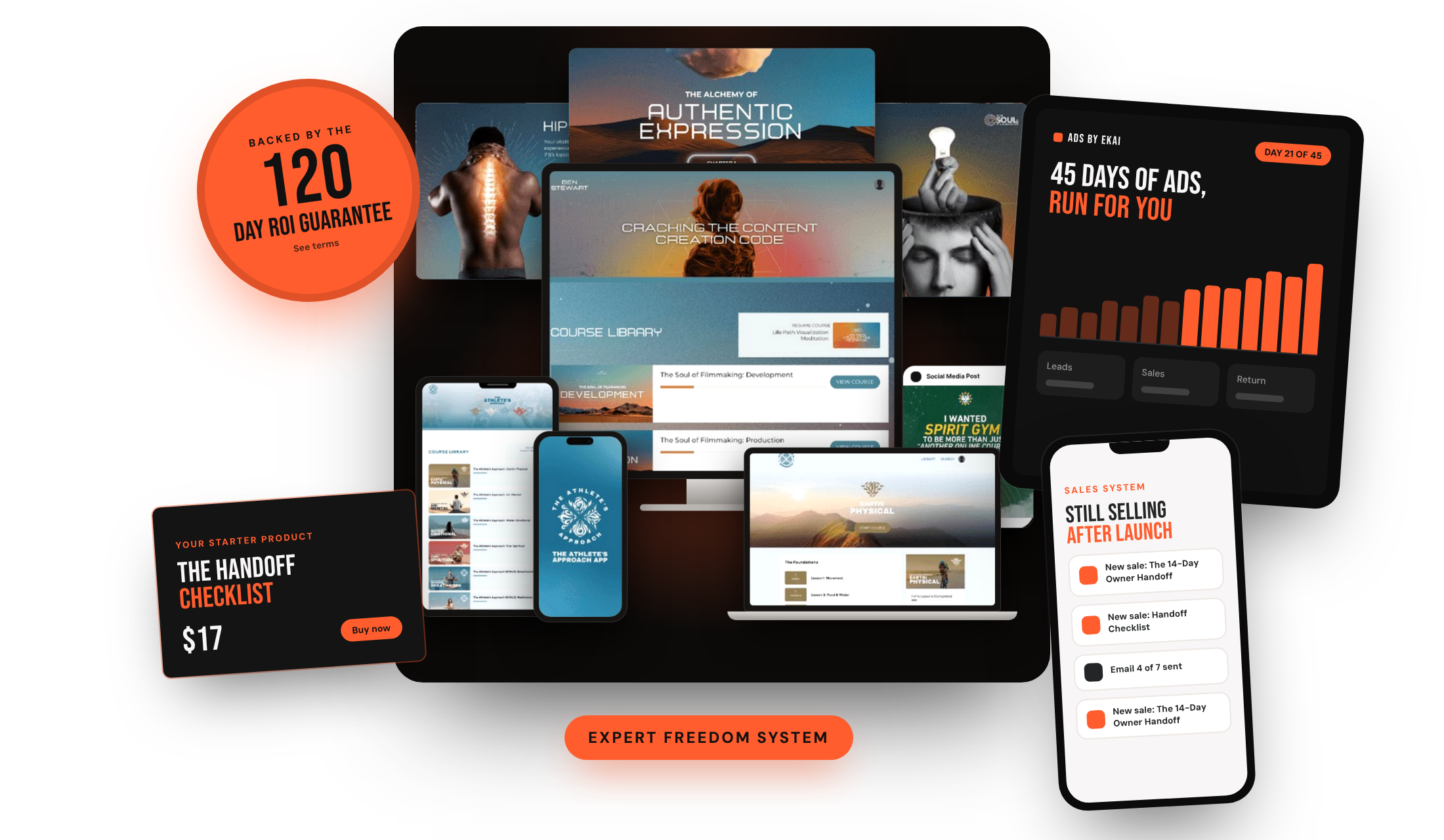
We run this model ourselves. The Expert Freedom Playbook is $17. It is a personalized plan that scores an expert business across eight systems and maps the first digital product.
The page says why it is priced that way: "Yes, that's a lot of value for $17. It's on purpose. The experts who buy this, take it seriously, and actually act on the strategy are usually the same experts we end up working with next."
That is the whole logic. The $17 is not the business model. It is the first handshake.
Composite example
Composite example, round numbers for illustration only. An expert spends $1,500 in a month on ads to a low-ticket product. Between the product and its order bumps, the average order comes to about $30. Fifty people buy. That is $1,500 back, so the front end breaks even.
Now the part that pays. Of those fifty buyers, a handful score as ready and book a call. If even one of them buys a high-ticket program, that sale arrived on ad spend the front end already covered. The same expert running ads straight to a call would have paid the full $1,500 for the same shot at that sale, with colder people on the calls.
Real numbers vary by who you help, offer, and creative. The structure is what holds.
Give it time before you judge it
A starter product path is not something you launch on Monday and judge on Friday. The ad platform needs data before it finds buyers reliably, and the backend needs time for booked calls to turn into sales.
I cover how long to let ads run before you judge it in Ads for a Course Launch: Why 45 Days Is the Minimum Read. The short version: judging an offer on its first week of spend is how good programs get killed early.
What to do next
List the smallest real win your method delivers: something a new person could get in a day. That is your front end product.
Decide where each type of buyer goes after the first purchase: who should book a call, and who should see a lower priced next step.
Before you spend on ads, set the number you will judge the front end on: the share of ad spend it gives back, not its profit.
If you want to see a front end from the buyer's side first, the Mini Course Playbook is one of ours, and it is $17.
If you already have proof that people pay you and want the full ladder, the starter product, and the ads built, book your build call.
Frequently asked questions
What is a low-ticket offer?
A low-ticket offer is a small, inexpensive product, usually somewhere between $7 and $97, that solves one specific problem fast. For an expert business, its main job is not profit. It turns a stranger into a buyer, lets ad spend pay for itself up front, and identifies the people most likely to be a fit for your higher priced offer.
Does a low-ticket offer hurt a high-ticket brand?
Not when it is built well. A strong low-ticket product shows your thinking and gives a real win, which builds trust before a sales call. What hurts a premium brand is a cheap product that feels like filler. Carve the low-ticket offer from your actual method so it feels like a sample of the real thing.
How much should a low-ticket offer cost?
Low-ticket offers usually sit between $7 and $97. Price it so a cold buyer can say yes without a call, and so the order, plus any order bumps, can cover a meaningful share of the ad cost to acquire that buyer. The exact number matters less than the product delivering a clear win quickly.
Can I run ads to a mid-ticket offer?
In the model we use, no. Ads run two jobs only: low-ticket sales and high-ticket booked calls. Mid-ticket offers are sold to people who already bought something or already trust you, through email and follow up, not through ads to strangers. That keeps the ad math clean and the mid tier profitable.
Stop selling your time. Real experts build assets.
Book your build call
45 minutes on Zoom with Mike or Ekai. We look at what you know, what it could be worth and exactly how we'd build it. We only take on 5 new builds a month.
Start with the $17 Mini Course Playbook
Names the mini course hiding in what you already teach, writes your offer, outlines every module and hands you a two hour build plan.

In your inbox in about 10 minutes.